GO! 2025 - European Capital of Culture Nova Gorica-Gorizia 2025
The cities of Nova Gorica and Gorizia, two of the three founding municipalities of the EGTC GO, held in 2025 the prestigious title of European Capital of Culture.
In 2025, the title was awarded to one city in Slovenia and one city in Germany (the winning city was Chemnitz). The title required the implementation of a cultural program lasting an entire calendar year, characterized by originality and a high level of quality.
Following Nova Gorica’s decision to apply together with Gorizia and the successful outcome of the bid, the two cities became the first cross-border European Capital of Culture in the history of the title. Nova Gorica’s application placed cross-border cooperation with Gorizia at its core, aiming to best enhance a unique cross-border territory.
TIMELINE
25/05/2019 – The mayors of Nova Gorica and Gorizia sign the cooperation agreement for the ECoC candidacy.
31/12/2019 – Deadline for submitting the bid book.
24/11/2020 – After the first evaluation by the independent expert panel, which shortlisted Nova Gorica and Gorizia, Ljubljana, Piran, and Ptuj for Slovenia, the second version of the bid book is submitted.
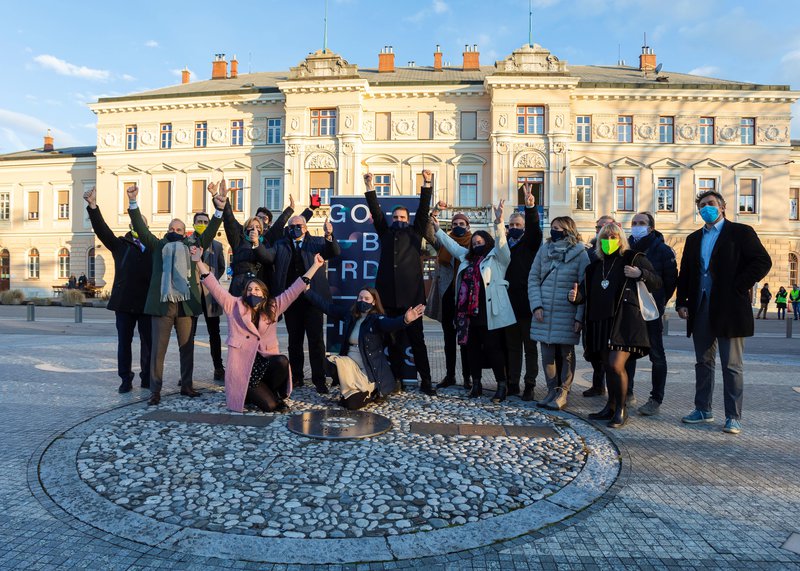
18/12/2020 – Nova Gorica and Gorizia are officially proclaimed European Capital of Culture 2025.
08/02/2025 – After four years of preparations carried out by the two municipalities, the EGTC GO, Javni zavod GO! 2025, and the Autonomous Region of Friuli Venezia Giulia, GO! 2025 – the European Capital of Culture Nova Gorica–Gorizia – is officially inaugurated.
The ECOC project has a dedicated website www.go2025.eu
Facebook @NovaGorica2025
Instagram @go_2025
Youtube GO!2025
Take a look to the final & winning Bid Book:
Sfoglia online
What is the European Capital of Culture?
The European Capital of Culture is an honorary title awarded each year to two cities from two different European Union Member States. The initiative aims to safeguard the richness and diversity of European cultures, highlight the cultural features shared by European peoples, and promote the contribution of culture to the long-term development of cities. The title also represents an exceptional opportunity for urban regeneration and for boosting tourism.
The European Capitals of Culture are one of the EU’s most recognized projects. The initiative was launched in 1985 by the then Greek Minister of Culture, Melina Mercouri. The idea is to place cities at the heart of cultural life across Europe. Through culture and art, European Capitals of Culture improve quality of life in cities and strengthen the sense of community. Citizens can take part in developing activities throughout an entire year and play a central role in shaping their city and its cultural expression. Being a European Capital of Culture brings new life to a city, enhancing its cultural, social, and economic development.
The benefits extend to all European citizens: European Capitals of Culture highlight the richness of Europe’s cultural diversity and offer a new perspective on shared history and heritage. They promote mutual understanding and demonstrate how the universal language of creativity opens Europe to cultures from around the world.
Being a European Capital of Culture brings real and lasting benefits. In particular, it generates economic growth, builds a sense of community, regenerates cities, and strengthens European connections.
The role of EGTC GO
The European Grouping of Territorial Cooperation EGTC GO was entrusted by the municipalities of Nova Gorica and Gorizia with preparing the European Capital of Culture bid. It was therefore a key actor from the very beginning of the process.
As a cross-border body, EGTC GO can operate both in Italy and Slovenia to implement joint projects and invest in the shared territory of the cities without being constrained by national or administrative borders, coordinating cross-border investments and realizing the concept of a single city.
After the title was awarded, the Slovenian public institution GO! 2025 – Javni zavod GO! 2025 was established to manage the official artistic program of GO! 2025.
EGTC GO was responsible for cross-border infrastructure projects and played a coordinating role among the main entities involved in the project.
Specifically, EGTC GO managed the GO! 2025 Small Projects Fund, through which around sixty cross-border projects were financed to support the Capital’s program. Further information is available in the dedicated section.
In addition, EGTC GO oversaw key infrastructure projects for the Capital. These include the redevelopment of Transalpina Square / Trg Evrope, the cross-border square connecting Gorizia and Nova Gorica, which hosted the opening of GO! 2025 and many other events throughout the year, as well as the go2025.eu platform, the single digital access point to the European Capital of Culture. This portal gathers information from numerous local, tourism, and cultural stakeholders, providing visitors and residents with everything they need to know about the cross-border area.
The theme of the GO! 2025 bid
Nova Gorica is inextricably linked to Gorizia through history and the many personal stories of its inhabitants; therefore, its bid was closely intertwined with that of the neighboring city. Located at the crossroads of three European cultures—Italian, Slavic, and Germanic—Nova Gorica, together with Gorizia, inherits a legacy of aristocratic tradition and embodies the living history of post-war Europe.
The wider ECoC area survived twelve offensives during the bloody First World War and was later divided by the Iron Curtain after the Second World War. This new city and Gorizia—an ancient provincial center—are places shaped by war and friendship, history and modernity, university life and cooperation. They live and breathe together despite, or precisely because of, their cultural diversity, forming a unique and compelling European territory.
The ECoC title represented an opportunity to connect all these elements and appeal to a European audience seeking tradition and modernity, originality and visibility.
The primary goal of the ECoC was above all to improve the quality of life of local residents. It provided a unique opportunity to connect, through cultural engagement, all the potential of the two border cities and their surrounding territory into a unified tourist, cultural, economic, educational, and infrastructural system—boosting economic growth, attracting cultural tourism, and enhancing quality of life for current and future inhabitants.
From the very beginning of the candidacy process, the “ECoC area” included the territory encompassing the Soča Valley, Brda, the Vipava Valley, the Trnovo–Banjšice Plateau, and part of the Karst region, extending across all municipalities within the Slovenian regional framework and, crossing the national border, including Gorizia as a partner city along with its provincial territory.
The guiding theme and slogan of the Nova Gorica–Gorizia European Capital of Culture project—GO! BORDERLESS—is coexistence and cooperation between the two countries, especially in the border area.
Related news
-
20.10.2026
EGTC GO at the Forum of Beauty: Borderless Wireless among the projects endorsed by the Fondazione Italia Patria della Bellezza
EGTC GO took part in the 2026 edition of the Forum of Beauty, an event dedicated to the role of culture and beauty as drivers of social and territorial …
Read all -
22.09.2026
The crossborder citizens' Assembly GO! 2025 has concluded its works
The process of the GO! 2025 Cross-Border Citizens’ Assembly concluded yesterday, 21 September at the EPICenter in Nova Gorica. The participatory initiative, promoted by EGTC GO and Zavod GO! …
Read all -
24.07.2026
The GO! 2025 Citizens' Assembly has met for the first time
The work of the GO! 2025 Citizens’ Assembly began yesterday.The first meeting took place at the Municipality of Nova Gorica, where citizens from Gorizia, Nova Gorica and …
Read all
Related events
-
08.05.2026
Contemporary art and cross-border territory
GO! Center, Corso Verdi 51, GoriziaA dialogue between artists and institutions on the proposals emerging from the GO! 2025 process Friday, May 8, 2026, 10:30 a.m.GO! Center Corso Verdi 51, Gorizia …
Read more -
02.12.2025
GO! 2025: Early Impacts of the Capital and Next Steps for the Future of the Cross-Border Area
EPICenter- Nova GoricaOn Tuesday, December 2nd, from 11 a.m. to 4 p.m., the new EPICenter spaces will host the event “GO! 2025: Early Impacts of the Capital and Next Steps for …
Read more -
16.07.2025
The intelligence of borders. Milanesiana in Gorizia
GoriziaThe event that will bring to Gorizia La Milanesiana, the famous cultural event conceived and directed by Elisabetta Sgarbi, on the occasion of GO! 2025, Nova Gorica Gorizia …
Read more